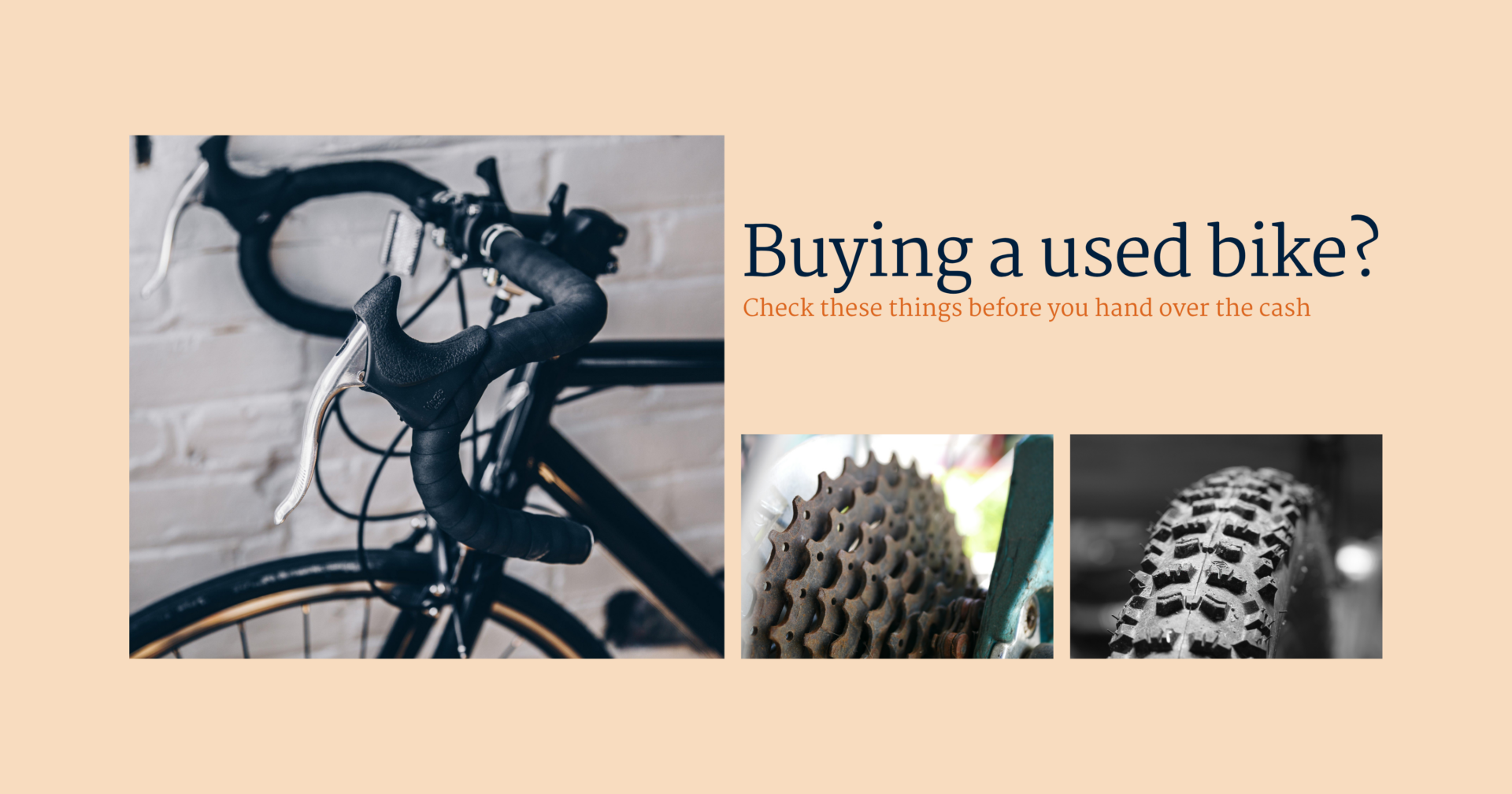
A used bike can be a great deal. It can also be somebody else’s problem that you’ve paid cash for. Before you hand over any money, check these things so you end up a happy rider.
Frame damage
This is the big one, because a bad frame usually means walking away. Look closely at the welds and the areas around them, especially where the tubes meet the head tube and the bottom bracket. Check the dropouts (where the wheel attaches) for cracks or bends. Look down the bike from the front and back to see if everything lines up.
Dents, deep scratches, and rust bubbling under the paint are all red flags. If the bike has been crashed or has been sitting in a damp garage, the frame will tell you. Carbon frames deserve extra suspicion. Damage can hide under the paint, so if something looks off, ask questions.
Wheel damage
Lift each wheel and give it a spin. It should run straight, with no wobble and no spot where it rubs the brake pads. Look for dents or flat spots in the rim, and check around the spoke holes for small cracks radiating outward (called “spidering”). Look for broken or loose spokes too. A wheel that needs truing is a cheap fix. A bent or cracked rim or a pile of broken spokes is a replacement.
Worn-out chain and drivetrain components
Chains stretch as they wear, and a stretched chain chews up the gears it rides on. Look at the teeth on the chainrings and cassette. If they look hooked or shark-finned instead of evenly shaped, they’re worn. A worn chain on its own is no big deal. A worn chain, cassette, and chainrings together add up fast.
Pedal it and shift through all the gears. Listen for skipping, grinding, or a chain that jumps under pressure. Some of that is adjustment. Some of it is a bike that has been ridden a lot of miles.
Weird one-off parts
Some bikes have parts that were only made for that bike, or for only a year or two. Odd bottom brackets, unusual handlebar and stem combinations, proprietary seatposts, and discontinued standards can all be hard to find and expensive to replace. A bike that’s easy to ride today can be a headache to keep running. If something looks unusual, ask about it before you buy, because the part you can’t find in two years will be the one that breaks.
Old rubber
Rubber ages whether the bike gets ridden or not. A bike that sat for years can look fine and still need a lot of work:
- Tires: Look for cracks in the sidewalls, dry-rotted rubber, and worn-down tread. Old tires can hold air and still be unsafe.
- Brake pads: Pads harden and crack with age and stop poorly. Check for worn-down grooves and rubber that feels like plastic.
- Grips: Sticky, flaky, or crumbling grips need replacing.
- Bar tape: Technically it shouldn’t be rubber, but it wears out the same way. If it’s frayed, filthy, or peeling, add it to the list.
E-bike batteries
This one is really hard to diagnose because the age of the battery is only a small factor in how well it performs. Batteries have a limited number of charge cycles in them, and when they reach that point they need to be replaced. Expect a new battery to cost $400 to $600 depending on the size and brand.
Is it stolen?
Nobody wants to think about it, but it happens. Ask the seller where the bike came from. Someone who really owns it can usually tell you its story, and might still have the receipt. Find the serial number (usually stamped on the underside of the bottom bracket) and check it against a registry like Bike Index or Project 529. Be suspicious if the price is far below what the bike is worth, if the seller is in a hurry, or if the answers don’t add up.
If you’re not comfortable, walk away. There will always be another bike.
Do the math
Even a good used bike usually needs a little love. A tune-up costs about $100, and new tires run anywhere from $50 to $200 a set. If it’s an e-bike, a replacement battery could add $400 to $600 on top of that. Factor all of it into your buying decision. A bike that’s $75 cheaper might not be the better deal once you add up what it needs.
A used bike can be a great find and we love keeping old bikes on the road. If you’re not sure about a bike you’re considering, just ask us. We are always happy to help you make sure you’re getting a great bike.