
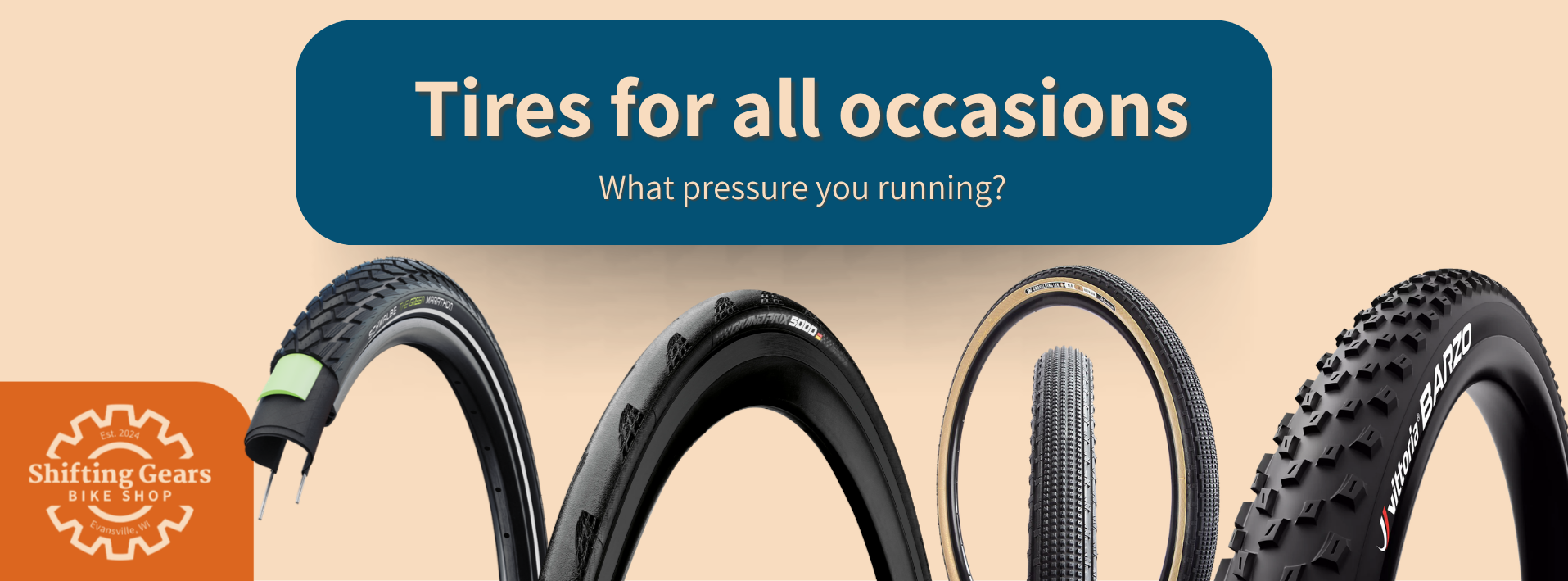
If you are looking for the single biggest improvement you can make to how your bike rides without spending a lot of money, the answer is almost always tires. Not a new drivetrain. Not a new saddle. We are simply talking about tires…
Most bikes leave the shop on tires that are fine. Adequate. They do the job well enough to get you riding. But fine tires and great tires feel completely different underneath you, and the gap between them is smaller than most people expect.
A good set of tires changes how your bike rolls, how it corners, how it absorbs the road, and how much energy you are putting into every pedal stroke.
That is a lot to ask of something that costs $40 to $60 a side.
Here is what to look for depending on where you ride.
Pavement: Comfort and Efficiency Start With Width
The old assumption was that narrower tires were faster on pavement. That has largely been proven wrong. A wider tire run at the right pressure rolls just as efficiently as a narrow one and absorbs road vibration in a way that makes longer rides noticeably more comfortable.
For pavement riding, we generally point people toward 28mm to 35mm widths. That range gives you a smooth, efficient roll on roads while adding enough volume to take the edge off rough pavement.
If you have been riding 23mm or 25mm tires and your hands or back ache after longer rides, wider tires are the first thing we would suggest trying.
We carry road tires from Vittoria, Kenda, Schwalbe, and Panaracer, i.e., brands that earn their spots on the wall.
Come in, and we will match you to the right option for your rim and your riding.
Gravel: More Width, More Options
Gravel riding asks more of a tire. You need something that rolls well on pavement between sections, handles loose or mixed surfaces with confidence, and does not punish you when the trail gets rough. Width is your friend here.
Gravel tires run up to 50mm or roughly 2 inches wide, and the tread options vary significantly depending on conditions. A tightly spaced, low-profile tread handles dry hardpack well and rolls quickly. A more open, aggressive tread grabs loose or wet surfaces and gives you confidence when things get unpredictable.
If you ride in a mix of conditions (and most gravel riders do), there are tires designed specifically for that middle ground.
The right gravel tire depends on where you are riding and what kind of surface you spend most of your time on. Tell us where you ride, and we will narrow it down fast.
Mountain and Trail: Match the Tire to the Park
Mountain bike tires are where tread pattern and compound matter most. The bike parks and trail systems in our area tend to reward a trail or cross-country style tire, something with enough grip to handle rooted or rocky sections without being so aggressive that it slows you down on the climbs and flat stretches.
If you are not sure what category your riding falls into, bring your bike in and describe where you ride. That conversation tells us more than any spec sheet, and we can usually point you in the right direction in a few minutes.
eBike Tires: Worth an Upgrade Too
eBikes put more load on tires than standard bikes. The added weight and torque wear tires faster, and the speeds involved make puncture resistance more important. If you are still riding on the tires your eBike shipped with, it is worth knowing that purpose-built eBike tires exist, and they make a real difference.
We carry options at the shop and are happy to talk through what fits your bike and how you ride.
Not sure where to start? That is what we are here for. Bring your bike in, tell us where you ride, and we will take a look at what you have and what might serve you better. No pressure to buy anything on the spot.
You will leave knowing exactly where you stand.